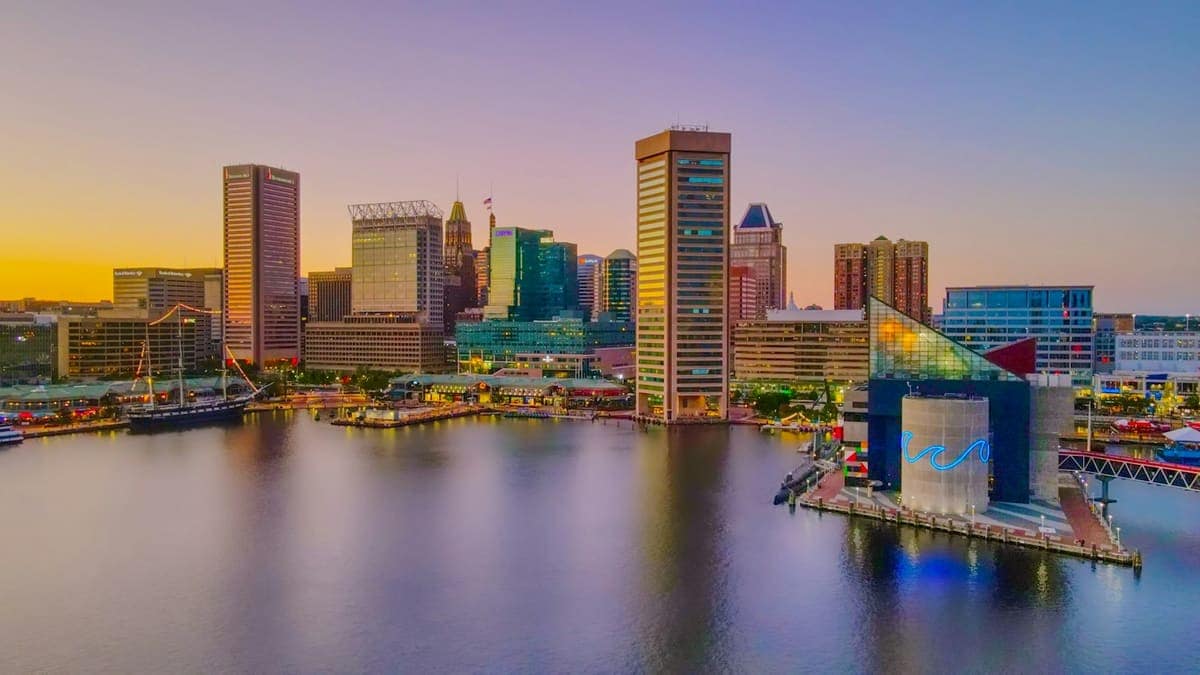

Baltimore is best understood one neighborhood at a time. According to Visit Baltimore, the city’s official tourism organization, areas such as Fell’s Point, Federal Hill, Hampden and Mount Vernon each have a distinct character, landmarks and history, and most can be explored on foot once you arrive.
This guide walks through many of the neighborhoods Visit Baltimore describes in its published neighborhood guide, grouped by part of the city, and ends with a few practical notes on getting around.
Which neighborhoods sit along the harbor?
Much of Baltimore’s identity is tied to the water, and several neighborhoods share the harbor shoreline.
Fell’s Point is known for ballast-block streets, centuries-old buildings, shipbuilding history and nightlife. Visit Baltimore says the Robert Long House, open for tours by reservation, is the oldest-standing residence in Baltimore City. The Frederick Douglass-Isaac Myers Maritime Park Museum honors what the guide describes as the first African American-owned shipyard in the country. The Horse You Came In On Saloon is described as the city’s oldest bar and is rumored to have been Edgar Allan Poe’s last stop.
Harbor East is described as a district of luxury hotels, boutiques and high-end dining. It is also home to President Street Station, where Abraham Lincoln stopped to avoid an assassination attempt, according to the guide.
Harbor Point is a 27-acre peninsula between Harbor East and Fell’s Point, according to Visit Baltimore. It is a modern waterfront development with harbor views and green space, including Point Park.
Canton and Brewers Hill feature a waterfront village square along O’Donnell Street with restaurants, pubs and shops, along with traditional painted screens and marble-stoop rowhomes. Brewers Hill takes its name from the National Brewery and Gunther Brewing, and the Mr. Boh sign still sits atop the former National Brewery tower.
Federal Hill is known for sweeping views of the Inner Harbor and historic brick rowhomes. Visit Baltimore lists the American Visionary Art Museum, Cross Street Market and the Baltimore Museum of Industry among its must-sees.
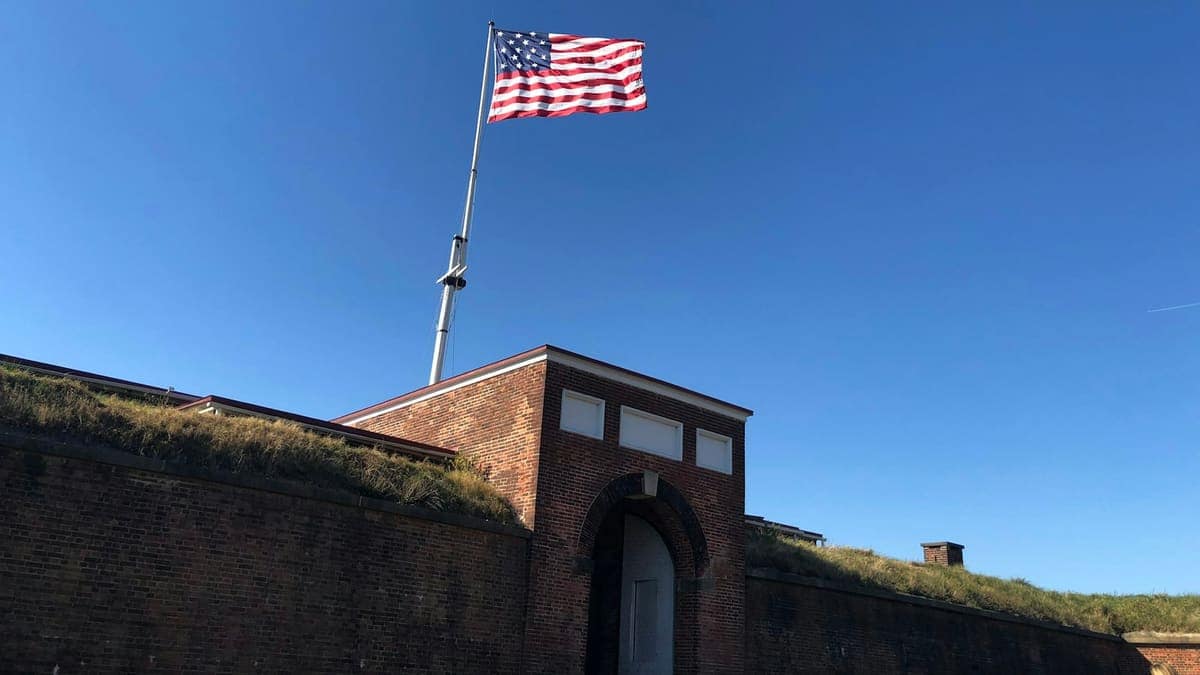
Locust Point sits next to Federal Hill and is home to Fort McHenry and the Domino Sugar sign. For the history of the fort, see our explainer on Fort McHenry and the Star-Spangled Banner.
What about the newer waterfront district?
The Baltimore Peninsula is a redevelopment of a former industrial port area in Port Covington. Visit Baltimore lists Sagamore Spirit Distillery, Nick’s Fish House, the Roost hotel and Volo Beach among its attractions, and says the redevelopment was started by Under Armour founder Kevin Plank. It is a reminder that the harbor is still changing, a theme that also runs through our look at the Port of Baltimore by the numbers.
Where are the arts and culture districts?
Several neighborhoods are organized around creative life.
- Station North is described as a creative hub near Johns Hopkins University and the Inner Harbor. It spans Charles North, Greenmount West and Barclay, and earned designation as the city’s first official Arts & Entertainment District in 2002. Graffiti Alley and Penn Station are among its landmarks.
- Bromo Arts District is known for artist studios, music venues, theaters and galleries. It is anchored to the south by the Bromo Seltzer Arts Tower, and its landmarks include the Hippodrome Theatre, Everyman Theatre and Lexington Market. Our profile of Lexington Market covers the market’s 1782 origins.
- Pennsylvania Avenue Black Arts and Entertainment District was a cultural center for Baltimore’s African American community. Visit Baltimore says the Royal Theater hosted Cab Calloway, Billie Holiday, Ray Charles and James Brown in the 1940s, 50s and 60s. The theater itself no longer exists, but a monument and a Billie Holiday statue mark the area.
- Hamilton-Lauraville offers shopping and food along Harford Road in northeast Baltimore, plus a growing arts scene. The Strand is described as Baltimore’s only brick-and-mortar theater solely performing works by female-identifying playwrights.
- Remington is home to artists, musicians and makers. R. House, a 10-stall food hall, is among its landmarks.
Which neighborhoods feel like small towns?
Hampden began as a 19th-century blue-collar mill town, according to Visit Baltimore, and is now known for eclectic shops, restaurants, vintage stores and street art on “The Avenue.” Its 34th Street holiday displays are a seasonal draw.
Little Italy is known for family-owned Italian restaurants and traditional desserts, and hosts the Feast of St. Anthony Festival each May. La Scala’s indoor bocce court is one of its landmarks.
Pigtown takes its name from the late 1800s, when cargo railcars from the Midwest let pigs out onto the streets, according to the guide. Its railroad heritage is on display at the B&O Railroad Museum, and the Babe Ruth Birthplace Museum and Mount Clare Museum House are nearby. The annual Pigtown Festival includes pig races.
Roland Park is described as a neighborhood of educational institutions, green spaces, architecture and local shops and restaurants.
Where can you find green space?
Druid Hill Park dates to 1860 and, according to Visit Baltimore, is a 745-acre urban park. It includes the Maryland Zoo, the Howard Peters Rawlings Conservatory and Botanic Gardens, a public pool, disc golf and tennis courts.
Patterson Park pairs green space with historic battle sites. Its Observatory, known as the Pagoda, offers panoramic views of the city, and the park has a lake, playgrounds, a swimming pool and an ice-skating rink. Neighboring Highlandtown is known for its Arts District and ethnic foods.
Mount Vernon is a National Landmark Historic District of grand 19th-century mansions, with the Washington Monument, the Walters Art Museum, the Enoch Pratt Free Library and Meyerhoff Symphony Hall, home of the Baltimore Symphony Orchestra.
Quick facts: neighborhood details at a glance
| Neighborhood | Known for | Fact from Visit Baltimore |
|---|---|---|
| Fell’s Point | Ballast-block streets, nightlife | Robert Long House is the oldest-standing residence in the city |
| Harbor Point | Waterfront development | 27-acre peninsula |
| Station North | Arts and music | First official Arts & Entertainment District, 2002 |
| Hampden | Shops, street art | Began as a 19th-century mill town |
| Druid Hill Park | Zoo, conservatory | 745 acres, dating to 1860 |
| Little Italy | Italian restaurants | Feast of St. Anthony Festival each May |
What is happening this weekend?
Visit Baltimore’s events listing for October 30 through November 1, 2026, includes a Fell’s Point Main Street Trick or Treat on Saturday, October 31, from 1 to 4 p.m., a Canton Halloween Pub Tour starting at So Pro on Friday, October 30, and a Fall Festival at Druid Hill Park on October 31. The Maryland Science Center holds a Pumpkin Smash on Sunday, November 1, from 10 a.m. to 1 p.m. Later in the season, the city’s Recreation and Parks listings show a Charm City Lights event on Saturday, November 28, 2026. Dates and times can change, so check the organizers before heading out.
How do you get between neighborhoods?
The City of Baltimore’s website lists the Charm City Circulator and the Harbor Connector under its “Getting Around” links. Locust Point’s Water Trolley is also named in Visit Baltimore’s guide. For rail options, including the Light RailLink, Metro and MARC, see our guide to getting around Baltimore. Service details change, so confirm routes and schedules with the operators.
A city best read in pieces
Visit Baltimore’s descriptions also show how much the neighborhoods overlap. Federal Hill and Locust Point share the Baltimore Museum of Industry, and Harbor East, Harbor Point and Fell’s Point run together along the same stretch of shoreline. The boundaries are looser on the ground than on a map, which is part of the appeal for first-time visitors and longtime residents alike.
Baltimore does not have a single center of gravity. Its waterfront streets, arts districts, mill-town avenues and large parks each tell a different part of the story, and Visit Baltimore’s guide offers a starting point for choosing where to spend a day. Pick one or two adjacent neighborhoods, such as Fell’s Point and Harbor East, or Federal Hill and Locust Point, and the rest of the map will fill in over time.
This article is general information based on published tourism descriptions. Hours, events and services change, so check with each venue or operator before you go.
Sources: Visit Baltimore; City of Baltimore