The Maryland Transportation Authority (MDTA) estimates that rebuilding the Francis Scott Key Bridge will cost between $4.3 billion and $5.2 billion, with the new bridge open to traffic in late 2030. To widen competition and speed awards, the agency announced in May 2026 that the remaining work would be split into four separate procurements.
What is the current cost and schedule?
According to the MDTA’s updated estimate, the final cost is expected to fall within the $4.3 billion to $5.2 billion range once negotiations with the design-builder, Kiewit, conclude. The agency lists a late-2030 open-to-traffic date.
| Item | Figure |
|---|---|
| Estimated cost range | $4.3 billion to $5.2 billion |
| Expected opening | Late 2030 |
| Main span | 1,665 feet |
| Total bridge length | 3,365 feet |
| Minimum clearance over the federal channel | 230 feet |
| Federal share of the project | 100% under Emergency Relief |
The May 2026 procurement announcement said the cost ranges match those of November 2025 and that the MDTA “remains confident in those estimates.” It also cautioned that a final construction schedule will not be known until the procurements are complete and contracts are awarded.
Why did the estimate rise?
The MDTA says the first estimates were prepared less than two weeks after the March 2024 collapse, before the design had advanced. It cites several reasons for the higher range:
- Materials: The agency says material costs have increased dramatically since the preliminary estimates.
- Pier protection: The cost of protective structures was not in the preliminary estimate. The new fenders are described as larger than a football field and are meant to reduce the risk of future ship strikes.
- A longer span: The main span is now 1,665 feet, which lengthens the bridge and requires taller towers and piers.
- Construction inflation: The MDTA points to Federal Highway Administration data showing a 72% rise in highway construction costs over five years.
Who is paying for it?
The MDTA says the federal share for the project is 100%, under Emergency Relief Program funding authorized in the American Relief Act. The state is advancing upfront construction costs and is contributing hundreds of millions of dollars in insurance proceeds. Maryland is also pursuing the vessel’s owner and manager for damages, and the agency says any money recovered would reduce the Emergency Relief liability for reconstruction.
How is the work being divided?
Kiewit Infrastructure Co. remains under contract and, according to the MDTA, will finish its contracted work through at least the end of 2026. That work includes driving permanent foundation piles and building a trestle, a work platform over the water. The rest of the project is divided as follows, based on the MDTA’s May 19, 2026 announcement.
| Procurement | Estimated cost | Construction start |
|---|---|---|
| Demolition and miscellaneous marine work | $50 million to $100 million | Fall 2026 |
| South land approach | $300 million to $400 million | Spring 2027 |
| North land approach | $200 million to $300 million | Spring 2027 |
| Main span and marine approaches | $3.5 billion to $4 billion | Summer 2027 |
Adding the four ranges gives illustrative arithmetic of $4.05 billion at the low end ($50 million + $300 million + $200 million + $3.5 billion) and $4.8 billion at the high end ($100 million + $400 million + $300 million + $4 billion). That sits inside the MDTA’s overall range, which also covers work already under the Kiewit contract. The MDTA did not publish that sum itself.
What will each contract build?
Demolition and marine work
This package covers removing and salvaging two three-span steel plate girder units over the Patapsco River, partially demolishing eight marine piers, demolishing three marine foundations underwater and fully demolishing two land piers. It also includes cleaning out 96-inch steel pipe piles.
The land approaches
The south approach calls for about 3,000 feet of approach bridge over land, ground improvements in a wetland and about 2,000 feet of roadway at grade. The north approach has about 2,400 feet of bridge over land and about 3,400 feet of roadway at grade. Both include stormwater features such as bioswales, grass swales and a submerged gravel wetland, along with intelligent transportation systems, electronic tolling and lighting.
The main span
The largest package is a cable-stayed bridge with a 1,665-foot main span, 3,365 feet in total and at least 230 feet of clearance over the federal channel. It includes vessel collision pier protection, about 660 feet of approach over the river on the south side and about 1,560 feet on the north side.
Why does the schedule matter to Baltimore?
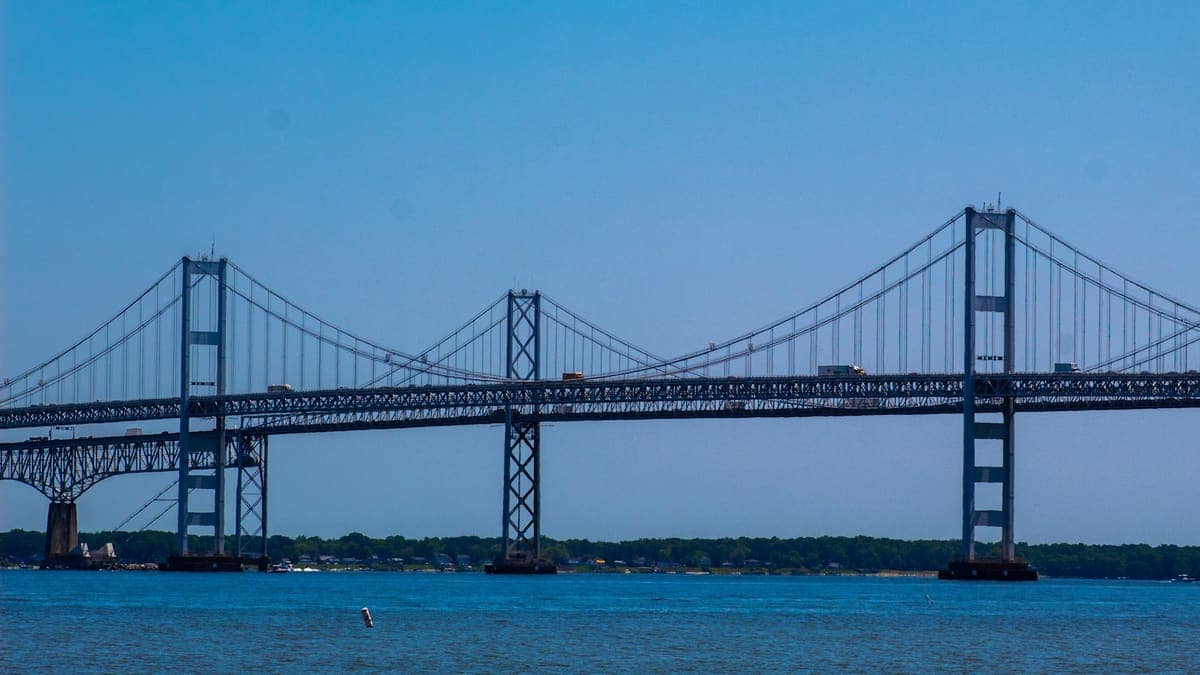
The bridge is part of the region’s road network and sits over the approach to the harbor. The 230-foot minimum clearance and the marine work are tied to the shipping channel that serves the city’s terminals, which our guide to the Port of Baltimore by the numbers describes. For drivers, the project is also a reminder of how much traffic depends on a few crossings, as discussed in our look at the Chesapeake Bay Bridge. Riders who use transit in the meantime can find options in getting around Baltimore by rail and bus.
What happens next?
As of the MDTA’s May 19, 2026 announcement, the planned sequence was an invitation for bids on the demolition work and a request for qualifications for the main span, both in summer 2026. Invitations for bids on the south land approach were planned for fall 2026 to winter 2027, and on the north approach for winter 2027. The agency says the design reached 70% in 14 months. Because the final schedule depends on contract awards, the late-2030 opening remains an estimate, and the cost range will be tested by the bids.
How to read the milestones
Three kinds of steps appear in the MDTA’s schedule, and they mean different things:
- Request for qualifications: used for the main span, it screens firms on experience before a price is requested.
- Invitation for bids: used for demolition and the land approaches, it asks contractors to submit prices for defined work.
- Construction start: the date the MDTA expects work on each package to begin, which depends on awards.
The order matters. Demolition is the first package expected on site, in fall 2026, and the two land approaches follow in spring 2027. The main span, by far the most expensive piece, follows in summer 2027.
What does the 70% design figure mean?
The MDTA says the project reached 70% design in 14 months and that groundbreaking was expected within months of its November 2025 estimate. In engineering practice, a design at that stage is well advanced but not final, so details can still change as the remaining drawings are completed and contractors price the work. The agency’s statement that the final cost will land within its range depends on those negotiations and bids. Readers should treat the published range as an official estimate rather than a fixed price.
A project still being priced
The Key Bridge rebuild is moving from planning into a phased construction program, with the largest and costliest piece not scheduled to begin until summer 2027. Readers following the project should watch for contract awards, since they will show whether the $4.3 billion to $5.2 billion range holds.
This article is general information based on published agency announcements, which may be updated.
Sources: Maryland Department of Transportation; Maryland Transportation Authority